

© Lyzer 2024. All rights reserved.

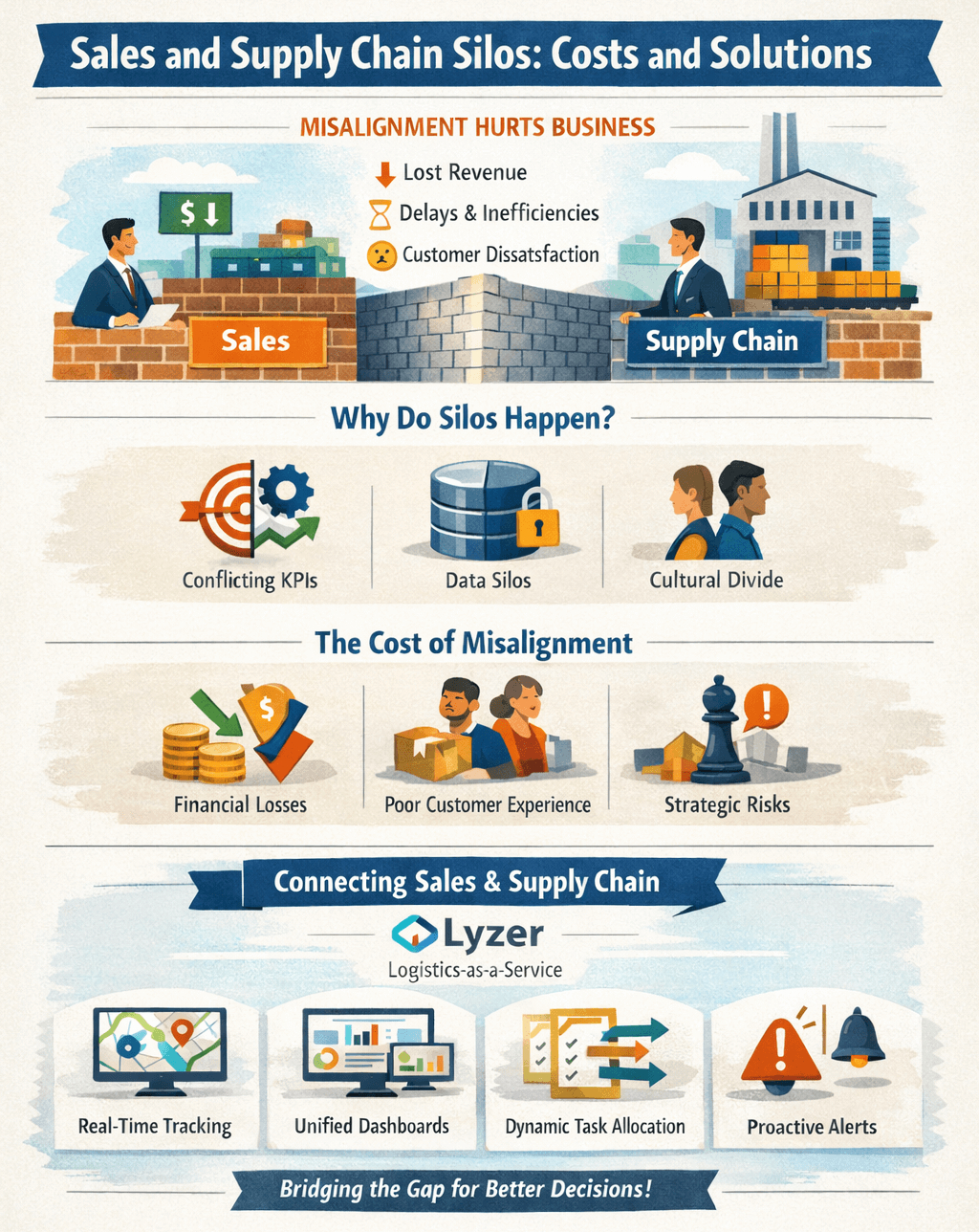
Large enterprises thrive when their internal functions work in harmony. Yet, one of the most common and costly barriers to efficiency is the silo between sales teams and supply chain operations. On one side, sales promise speed, flexibility, and tailored service to customers. On the other hand, supply chain teams manage the complex task of delivering on those promises while dealing with logistics constraints.
The result? Misalignment that creates friction, inefficiency, and lost opportunities. Data silos and organizational separation between these teams are among the top drivers of lost revenue and decreased customer satisfaction.
This article explores why sales and supply chains often operate in silos, the tangible costs of misalignment, and how Lyzer provides a bridge, bringing real-time visibility and decision intelligence to executives who need clarity.
In a business context, silos emerge when teams operate in isolation, protecting their own data, goals, and processes instead of working toward shared objectives.
In the case of sales and supply chain, these silos create invisible walls that prevent collaboration, limit visibility, and make it harder for executives to align strategy with execution.
A silo forms when departments operate independently, with limited communication or shared objectives. Sales focuses on revenue growth, customer acquisition, and market expansion. Supply chain teams concentrate on operational efficiency, cost control, and risk management. Without integration, each function optimizes different goals, leading to friction.
Data silos magnify this organizational divide. Critical information about orders, delivery status, or customer commitments gets trapped in isolated systems. Sales teams promise delivery timelines without access to operational realities. Supply chain managers plan logistics without knowing the urgency or context behind sales priorities.
Sales and supply chain teams rarely set out to work against each other. Yet, what starts as a difference in focus (like customer acquisition versus operational efficiency) gradually grows into misalignment that impacts performance. Understanding the main drivers of this drift is the first step toward building stronger collaboration.
Sales teams are measured by revenue targets, while supply chain teams are evaluated on cost efficiency and service reliability. These KPIs push departments in opposite directions: sales may overpromise to close deals, while supply chain pushes back to avoid inefficiencies.
Outdated reporting processes force decisions based on partial or lagging data. Sales teams often lack real-time insight into delivery capacity or courier performance. Supply chain lacks visibility into live customer demand signals.
Sales teams tend to be customer-facing and outward-looking. Supply chain functions are operational and internally focused. This cultural gap reinforces structural silos, where collaboration happens only reactively. More often than we realize, problems have already escalated.
Misalignment between teams carries measurable costs that affect revenue, customer loyalty, and long-term competitiveness. From financial waste to reputational damage, the impact of siloed operations can be felt across every level of the enterprise.
According to industry studies, companies lose billions annually due to inefficiencies tied to siloed operations. Common issues include:
Big Business Agency notes that when sales and customer-facing functions are disconnected from the supply chain, customers suffer. Late deliveries, broken promises, and poor communication damage loyalty and brand trust.
Misalignment creates blind spots for executives. Without integrated visibility, leadership cannot anticipate risks or make strategic decisions. This leads to slower response times, reduced agility, and exposure to competitive threats.
This is where Lyzer’s Logistics-as-a-Service delivers unique value. Lyzer provides real-time intelligence and execution visibility that connects sales priorities with supply chain realities.
Sales teams gain instant insight into order progress, from in-store picking to last-mile delivery. This transparency enables them to set realistic customer expectations.
Supply chain teams use Lyzer to optimize resources. Tasks are automatically reassigned to available couriers or store staff, reducing bottlenecks and delays. Sales can see these adjustments in real time, aligning promises with execution.
Executives and managers access a single source of truth. Sales performance data and supply chain execution metrics coexist in one platform, removing the friction caused by scattered tools.
When risks arise (such as potential delivery delays) Lyzer issues alerts. Sales teams can communicate proactively with customers, while supply chain teams act to resolve the disruption.
When both sales and supply chain teams share visibility and objectives, executives gain the clarity and speed they need to make informed decisions. The benefits extend across profitability, customer trust, and long-term resilience, creating measurable impact at the top of the organization.
Executives no longer wait for siloed reports. Real-time insights enable strategic moves with confidence.
With sales and supply chain aligned, companies reduce costly last-minute adjustments and avoid overpromising.
Transparency and reliability build customer trust, leading to repeat business and long-term loyalty.
Leaders gain the ability to anticipate demand shifts, manage disruptions, and pivot strategy without waiting for manual coordination.
Some Questions and Answers about Supply Chain from Lyzer!
Why do sales and supply chain teams often operate in silos?
Because each team focuses on different KPIs, uses different systems, and lacks real-time visibility into the other’s operations.
What are the costs of this misalignment?
Financial losses, customer dissatisfaction, and slower executive decision-making.
How does Lyzer help reduce silos?
By providing real-time logistics intelligence that connects order progress, task allocation, and delivery visibility in one platform.
What is the strategic advantage for executives?
Executives gain clarity, speed, and agility in aligning sales promises with supply chain execution. This will reduce risk and improve competitiveness.
In which industries is Lyzer’s technology most useful?
Silos between sales and supply chain teams are not just operational inconveniences. They are strategic risks with measurable financial costs. Misalignment leads to broken promises, dissatisfied customers, and missed opportunities.
By contrast, when sales and supply chain align through real-time visibility and shared intelligence, enterprises unlock efficiency and resilience. Lyzer’s Logistics-as-a-Service acts as the connective tissue, ensuring that promises made in the boardroom or sales pitch can be executed flawlessly in the real world.
In a competitive landscape, eliminating silos is essential for growth and customer trust.
References:
Contact Lyzer to learn more about our innovative logistics solutions.