

© Lyzer 2024. All rights reserved.

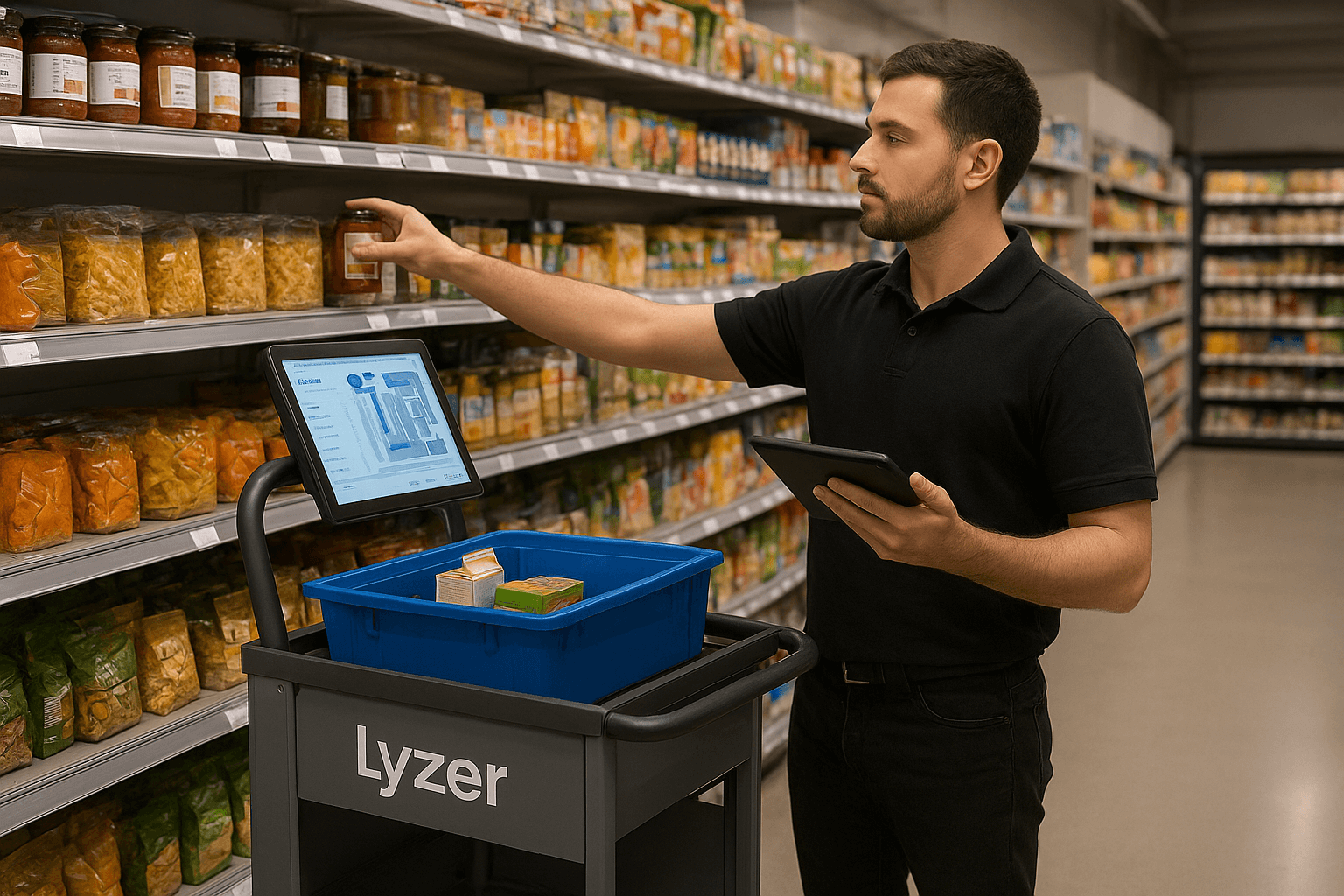
In physical retail environments, “picking” is the process of selecting and assembling items for customer orders within the store. It may seem like a mundane logistic step.
But in fact, if your in-store picking operation is inefficient, it can silently erode your margins, one order at a time. In this article, we walk through the warning signs that your operation is bleeding value and why Lyzer’s picking solution is built exactly to plug those leaks.
Retailers know that margins in in-store retail are often razor-thin. Even small inefficiencies compound quickly when multiplied across thousands of orders monthly.
What often gets overlooked is that picking is one of the backstage culprits: every wasted minute, every mis-picked item, every unnecessary movement chips away at profit.
In fact, the concept of revenue leakage is well understood in broader business circles: the idea that a business fails to collect or protect revenue due to process gaps, inefficiencies, errors, or system misalignment.
Though often discussed in subscription or service businesses, revenue leakage is equally relevant in retail operations. The margin drain may occur long before revenue is recognized. In retail, we see these leaks in inventory errors, incorrect order fulfillment, rework, labor inefficiency, and opportunity cost.
Margin analysis also reinforces the point: the difference between revenue and cost is not just in big line items like rent or inventory. The small, repeated inefficiencies matter. Analyzing margins helps identify which products or operations are profitable and which are dragging results.
Thus, when picking becomes suboptimal, it “eats your margin.” This is how Lyzer can help your business to close the gap.
As an organic store, it is important that our products reach customers fresh and on time, and their network of delivery providers has made it easier for us to do just that. The system is straightforward, and knowing we have reliable software and logistic solutions in place takes a lot of pressure off our team.
Pedro Barroso, CEO, Miosotis
If your store team regularly picks the wrong SKU, misses items, or substitutes unwanted alternatives, you incur direct costs: restocking, returns processing, and potential spoilage (for perishables). These errors shrink your margin by increasing handling costs and losing sales confidence. Recurring mis-picks indicate poor visibility or routing in your picking workflow.
Pickers walking inefficient paths or retracing steps is a silent killer. If your pickers are not guided along an optimized collection path, each extra few meters and each backtrack adds seconds per item, and therefore cumulatively that’s hours lost per shift. The image you provided suggests Lyzer’s system supports a “collection path” design that directs pickers along the fastest in-store route. That kind of optimization is critical to minimize wasted time.
When you allocate picking tasks ad hoc, without regard to picker location, workload, or capacity, you provoke idle time, bottlenecks, or uneven distribution of effort. In the image, Lyzer promises automatic order assignment: intelligent distribution based on location and workload. That ensures no picker is overburdened or underutilized, preserving efficiency.
If pickers handle each order in isolation, they’ll run back and forth more frequently. Batching items for multiple orders in one trip reduce travel overhead. The image labels an “intelligent multi-order cart,” designed to group items from several orders into one collection journey that can cut time and store traffic. Without that kind of strategy, you lose margin by paying the travel cost repeatedly.
If you don’t monitor picking performance in real time (e.g., time per pick, delays, bottlenecks) you lose control over root causes. Moreover, pickers without immediate feedback can waste time on low-priority items or inefficient paths. You need visibility into your picking flow so you can adjust on the fly.
A pick operation with many exceptions, such as items out of stock, shelf fetch delays, substitutions, can cause rework. That additional labor and operational friction is rarely accounted for in budget planning, but it chips away at margin. A mature picking system must absorb or minimize these exceptions, not amplify them.
When these signs are present, your operation is “leaking” value. Often quietly, but steadily. Over time, the cumulative loss can amount to several percentage points of margin, far beyond what many retailers expect.
To understand why these leaks matter, consider:
Because margin is revenue minus cost, any hidden cost in the picking chain directly erodes profitability. Margin analysis helps expose these leakages by isolating cost drivers per SKU or per operation.
In many industries, businesses lose between 5% and 9% of potential revenue through leakage. Imagine if picking inefficiencies accounted for just half of that in your store. That’s a meaningful margin drag.
Lyzer’s picking solution addresses exactly the types of leaks described above. Here’s how the platform stacks up and why it’s an optimal choice for businesses:
At makro, we are always looking for ways to innovate and improve efficiency, so finding a partner who could help streamline processes without compromising on quality was key. Their picking and transport integrated solution have proven valuable to meet our ambition and, most importantly, our customers’ expectations.
Inês Resende, Business Development Manager, makro
Lyzer combines data about order location and picker workload to automatically assign orders to pickers in the most efficient way. That avoids overloading individuals, cuts waiting times, and ensures smooth flow in your staff. This type of dynamic load balancing is foundational to preserving margin in busy environments.
The system generates an in-store collection path that minimizes picker travel. Instead of random zigzag picking, Lyzer leads your team along the fastest route. This reduces walking distance, speeds fulfillment, and shrinks wasted seconds per order.
With its intelligent multi-order cart feature (as indicated in the image), Lyzer allows pickers to collect items for multiple orders in a single trip. That transforms picking from a one-order-at-a-time chore into an efficient batch process, which is a major boost to throughput and margin.
Lyzer monitors picking in real time, tracks metrics like submission times, items processed, delays, and routes used. This transparency enables managers to spot bottlenecks or inefficiencies early, intervene, and continuously improve performance.
Real operations always face anomalies: out-of-stock items, wrong shelves, returns. Lyzer’s system is designed to accommodate exceptions smoothly, minimizing rework and redirecting pickers proactively. The less friction in these edge cases, the less margin erosion.
Because Lyzer collects operational data, you can analyze batch performance, route effectiveness, picker productivity, and other KPIs. Over time, you can refine your picking model. It will be optimizing aisle layouts, staffing patterns, and resource allocation to further protect your margins.
In short: Lyzer doesn’t just automate picking: it optimizes it. It plugs the leakage by compressing travel time, minimizing errors, balancing load, increasing throughput, and providing visibility. That combination is what sets it apart.
Before you adopt any solution, you need to be convinced that picking is indeed a leak in your operation. Here’s a practical checklist:
If any of these uncover inefficiencies, those are signals your margin is at risk.
In modern omnichannel retail, operations are directly tied to your profitability. Picking is one of those critical nodes: if it’s inefficient, you will literally pay for it in margin.
Lyzer’s picking service addresses the most common and damaging leaks in in-store operations. By offering automated order assignments, optimized paths, multi-order batching, real-time tracking, and built-in exception handling, Lyzer acts not just as a tool but as a guardrail against margin bleeding.
Sources:
Replicon, What Is Eating Your Profit Margins
Chart Expo, Margin Analysis
Olabi, Revenue Leakage In Retail And Its Hidden Costs
KPMG, What Is Value Leakage
Stripe, What is Revenue Leakage, How to Detect it and Prevent it
Contact Lyzer to learn more about our innovative logistics solutions.